They say the geek shall inherit the Earth. I’m counting on it.

  • Death Line is a 1972 horror film starring Donald Pleasance, and featuring a cameo appearance from Christopher Lee.

    Student Patricia, and her American boyfriend Alex, are travelling on the London Underground late one evening when they find a respectable looking man lying unconscious on the stairs. After eventually convincing a policeman to investigate, they discover that the mystery man has disappeared.

    As it turns out, the vanishing man is actually quite an important person, so Donald Pleasance’s Inspector Calhoun is tasked with investigating the disappearance. He uncovers an urban legend about a group of railway workers who were trapped by a cave-in, their descendants still living below ground.

    It couldn’t possibly be true, could it?

    Death Line is actually a very very good film. The reviews for it are overwhelmingly positive, and it is easy to see why. Donald Pleasance and Norman Rossington are both excellent as Calhoun and DS Rogers. They are a very funny double act and end up providing a lot of unexpected humour.

    And believe me this humour is needed, because Death Line is very grim and also incredibly bleak. The scenes in the mutants’ lair, with the rotting remains of unfortunate commuters, does not leave a lot to the imagination.

    Apart from Pleasance and Rossington, Hugh Armstrong is ridiculously sympathetic as the lead cannibal (not a sentence I ever thought I would write). The scene where he repeatedly shrieks, “Mind the doors!” is terrifying and heartbreaking in equal measure.

    In fact, it is difficult not to have an element of sympathy with the mutant, cannibalistic underground dwellers, despite their murderous ways. There is an interesting juxtaposition between Manford – the very well-off first victim whose disappearance sparks the initial investigation – and the cannibal antagonists. It is almost a class thing, the upper class versus the exploited working class, and how the so-called ‘lower class’ is treated.

    Or maybe it is just a film about mutant cannibals killing unsuspecting commuters.

    Either way, it is a very good film, just not one I feel the need to revisit on a regular basis.

    Fediverse Reactions
  • Tentacles is a 1977 horror / thriller / utter embarrassment, directed by Ovidio Gabriel Assonitis.

    In yet another Jaws rip-off, residents of a U.S. coastal town are disappearing in strange circumstances. Enter reporter Ned Turner, played by John Huston (I mean, come on, John Huston, what was he thinking?)

    We soon discover that the good townsfolk are being picked off by a giant octopus (I mean, obviously) and it is up to Bo Hopkins’ mean and moody hero Will to save the day. (I am not entirely sure how Will comes to the conclusion it is a giant octopus. Hopkins has a terrible habit of not opening his mouth to speak, so I might have missed the explanation).

    Anyway, chuck in Shelley Winters, Henry Fonda, some awful dubbing and a really bizarre soundtrack, and the scene is set for 90 minutes of unintentionally hilarious shenanigans.

    To be fair, there is quite a neat scene at the start when a mother leaves her child in its buggy at the waterside to go and talk to her friend. (Let’s ignore the fact that she left her kid alone). We see the buggy in the background with traffic passing along the road in front of it, obscuring our view. And then a bus passes by and suddenly the buggy is gone. It is a clever little moment, still kind of shocking even though we are expecting it. But sadly, this is as good as the film gets. There are a couple of quite hilarious moments, especially when the octopus causes absolutely carnage at a children’s boat race.

    Honestly, this is typical 1970s TV move fare and it’s awful. It has a funky soundtrack which is so out of place, especially during the moments when people are being killed by the beast.

    Acting wise, John Huston and Henry Fonda are fine, but they must have been paid an awful lot to do this. Shelley Winters (over)acts her little socks off, and Bo Hopkins is suitably heroic as Will, even though he irritated me so much by not speaking clearly.

    Once seen, never forgotten!

    Fediverse Reactions
  • Lust for a Vampire is a 1971 British Hammer horror film, written by Tudor Gates and directed by Jimmy Sangster.

    The film, which is part two of the so-called Karnstein Trilogy, is set 40 years after 1970’s The Vampire Lovers, and tells the story of novelist Richard LeStrange, who comes to a village to do research for his books about the occult.

    He is warned about the upcoming return of the mysterious Karnstein family who live in their remote castle and prey on young virgin women.

    Obviously LeStrange thinks that it is all supernatural nonsense.

    But is it?

    Well, it is Hammer, so what do you think?

    We start off with the count and countess attempting to resurrect their long-dead daughter (quite a startling scene, I have to admit), and end with marching locals carrying burning torches.

    Typically Hammer fare, to be honest.

    The positives are that it has a wonderful Gothic look about it. The film creates a fabulous atmosphere, due in no small part to the music. Some scenes are accompanied by very evocative choral singing, which makes the film quite beautiful to look at and very haunting.

    As this is the 1970s, we have reached peak Hammer horror, with multiple boob shots, naked women, and one of the most bizarre love scenes ever.

    Basically Yutte Stensgaard (she can’t act, but clearly she’s not there for her acting ability), as she is being seduced by Michael Johnson’s pound shop hero LeStrange, decides the best way to convey her feelings of ecstasy is by making herself cross-eyed. At the same time, the whole scene is accompanied by a modern-day pop song playing in the background.

    It is unintentionally hilarious.

    Apart from Ms. Stensgaard, the acting is okay. Michael Johnson is instantly forgettable, but Ralph Bates is as reliable as ever as the creepy Giles Barton.

    It is definitely not one of the best, but an interesting example of the sexier, more explicit films of the 1970s.

    Fediverse Reactions
  • Doomwatch was a British sci-fi TV series which ran between 1970 and 1972. It was created by Gerry Davis and Kit Pedler, who were both well known for their work on Dr. Who.

    38 episodes were made over the course of three series, but only 24 survived, and one episode has never been broadcast.

    The word Doomwatch referred to the “Department for the Observation and Measurement of Scientific Work”. It was overseen by Dr. Spencer Quist, played by John Paul, a man haunted by his guilt of working on the Manhattan Project. Joining him was Dr. John Ridge, played by Simon Oates, a man who would try to get his leg over anything with a pulse.

    More about that in a second.

    Series one also had Robert Powell as Toby Wren, whose unexpected death in the first series finale brought endless complaints to the BBC.

    The show tackled topics such as toxic waste, noise pollution and unknown viruses. These are subjects which we are so used to talking about now, but 50 years ago it must have been unusual – and quite frightening – to see this subject matter playing out on national TV.

    I think sometimes the best sci-fi writers have a gift for looking into the future and telling stories which need to be told, without perhaps realising just how important these topics are. Doomwatch was no exception, although Davis and Pedler left after series two and it is widely agreed that the show became more of a standard thriller type, and perhaps lost some of the environmental aspects which made it so unique.

    The one negative, and to be fair it is a big ‘un, is the appalling sexism and general treatment of female characters. Dr. Ridge treats every woman as a potential conquest, which, through the eyes of someone living in the modern world, is toe-curling to say the least.

    And yet, I do like the randy doctor. He makes me laugh a lot. So I find that the best way to deal with the sexism is just laugh it off and be thankful that society has changed for the better. It is not perfect by any means, but definitely better than it used to be.

    Doomwatch is typical 1970s TV – slow moving, talky, dodgy effects – but I do not have a problem with that. At its best, it was an environmental thriller, introducing the viewer to topics which probably felt very alien, but, as we know today, are very real.

    If I had been old enough to watch it at the time, I would have been quite concerned to think about what the future might hold.

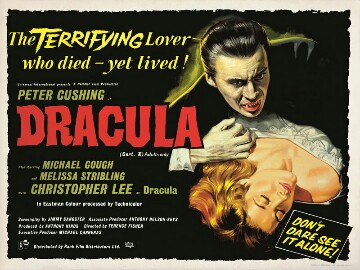
  • The Satanic Rites of Dracula is a 1973 Hammer film, written by Don Houghton and directed by Alan Gibson. It stars Christopher Lee, making his final appearance as Dracula, and Peter Cushing as Professor Van Helsing.

    Set in 1970s London, the plot resolves around the secret service investigating apparent satanic rituals at an English country house, with the revelation that prominent members of society are somehow involved. From here, the story takes some rather bizarre turns and ends up being a curious mix of spy thriller and horror.

    I think the main problem with this film is that the plot could best be described as “thin”. Dracula doesn’t appear until roughly 30 minutes into the film (although his first scene is memorable and very well done) and Christopher Lee looks as though he can’t really be bothered and is simply going through the motions.

    In amongst the unexpected plots twists (bubonic plague, anyone?) and gratuitous female nudity – which all feels a bit grubby – Peter Cushing is as reliable as ever, with his trademark gravitas as Van Helsing.

    Michael Coles is also very good as Inspector Murray, reprising his role from 1972’s quite hilarious Dracula AD 1972. There are also nice supporting turns from the likes of William Franklyn and Freddie Jones.

    To be fair, the film does have a couple of memorable scenes, the standout moment being when Joanna Lumley’s Jessica discovers the vampire women in the basement of the mansion. This whole scene plays out as something out of a nightmare, and I think it is very effectively done.

    I do have a soft spot for The Satanic Rites of Dracula. It may be a curious horror / spy / conspiracy thriller hybrid, and absolute nonsense for that matter, but it is infinitely better than Dracula AD 1972, which was enjoyable for all the wrong reasons.

  • Quatermass II is a 1957 Hammer sci-fi / horror which sees Brian Donlevy reprise his role as Professor Bernard Quatermass. Co-written by Nigel Kneale and Val Guest (who also directed), the story concerns an investigation into reports of hundreds of meteorites landing within a small area in the U.K.

    Quatermass finds a top-secret facility which, he is told, is being used to manufacture synthetic food. Of course this could not be further from the truth, and the professor and his allies must join forces to try and smash a conspiracy which appears to strike at the heart of the U.K. government.

    Quatermass II is a neat little conspiracy thriller which has a real sense of dread throughout its entire running time. It has quite an Invasion of the Body Snatchers vibe about it which, in my opinion, is no bad thing.

    The supporting cast here is very good, with the likes of Bryan Forbes and William Frankyln, and also Sid James who, at the time, was best known for playing tough guy roles, a million miles away from the career he eventually carved out in comedy.

    The real problem for me is Brian Donlevy as Quatermass. He is perfectly okay but I just do not find him terribly likeable. For me, Andrew Keir will always be the definitive Bernard Quatermass.

    Despite reservations about Donlevy, there is much to recommend about Quatermass II. The acting is good, it is never boring, and all in all, it is a highly entertaining conspiracy thriller.

    Definitely one to watch.

  • The Swarm is a 1978 U.S. disaster / horror movie, directed by Irwin Allen, AKA The Disaster Master, and starring Michael Caine and a bunch of famous faces who really ought to have known better.

    Basically, a swarm of African killer bees are on the loose, taking out military helicopters, random picnicking families, and a whole train load of passengers. Thankfully, Dr. Michael Caine is on hand to offer assistance and help defeat the pesky critters, which he eventually does after nearly two hours of utter tripe. (Or if you are like me and accidentally end up watching the ‘director’s cut’, two hours and 25 minutes).

    The Swarm has all the usual cardboard cutout characters – Caine’s doctor who isn’t believed, Katharine Ross as his love interest, Richard Widmark as a shouty no-nonsense army man, and most bizzarely, old-timers Olivia de Havilland, Ben Johnson and Fred McMurray as a strange love triangle who appear to have wandered in from a completely different film.

    To be fair, a couple of the bee attack scenes are quite well done, especially when they attack the school and Olivia de Havilland’s Maureen looks on in horror at the dead bodies scattered across the schoolyard. The problem is, the rest of the film is so tedious, with terribly ripe dialogue (“Get inside, the killer bees are coming!”) that all we want to see is the next bee attack.

    The Swarm is a classic B-movie – see what I did there – with an A-list cast, and it stinks. It takes itself far too seriously and has little to no redeeming qualities. If you want to see the perfect example of how to do a B-movie, go watch Piranha, which came out the same year. It is everything The Swarm isn’t – fun, silly, with extremely likeable characters.

    And remember people – “The bees have broken inside!!”

    Fediverse Reactions
  • The Stone Tape is a 1972 British horror drama, written by Nigel Kneale and directed by Peter Sasdy. It was first broadcast on U.K. TV on Christmas Day of that year.

    A team of researchers for an electronics company move into an old Victorian mansion. Amongst the team is Jill, a sensitive computer programmer, and Peter, the arrogant team leader with whom Jill is having a relationship.

    In one particular room, where the builders refused to work, Jill begins to have visions of a frightened young woman falling to her death. She and a reluctant Peter begin investigating and discover that a maid died there in 1890.

    Peter thinks Jill’s “vision” of the woman’s death was somehow recorded and preserved in the stone – the so-called ‘stone tape theory’. He sees this as potentially a new recording medium to be exploited, but his actions send the fragile Jill to the edge of madness.

    And beyond.

    I have said before that I think Nigel Kneale is an absolute genius, and The Stone Tape is one of my all-time favourites.

    It has a very nice, suitably creepy atmosphere, with an interesting mix of modern technology set against old-fashioned beliefs. The clever story is augmented well by a haunting and minimalist electronic score, which adds to the sense of things being just slightly “off”.

    The acting is good, especially Jane Asher as the fragile Jill. Michael Bryant is very shouty as Peter – perhaps too much – but I think it does help emphasise how utterly obnoxious he is. The supporting cast is good, with standout turns from Iain Cuthbertson and Michael Bates.

    There are a couple of cringy moments, with some casual racism now and then, and Peter’s treatment of Jill is toe-curlingly sexist.

    Overall though, this really is a superior 90 minute drama, and one of the greatest dramas ever to appear on the BBC.

  • Terror at London Bridge is a 1985 TV movie about a series of murders in Arizona being attributed to Jack the Ripper.

    It stars David Hasselhoff – AKA The Hoff-Meister – as a troubled detective investigating a series of murders which are somehow connected to the relocated London Bridge.

    We start off in 1885 with Jack the Ripper being pursued across the bridge in London, before falling into the Thames, knocking a stone off the bridge in the process.

    Fast-forward to 1985 and the missing stone is rediscovered and added to the resurrected bridge which now sits in Arizona. Next thing we know, a random tourist cuts her finger and bleeds on the stone, which, of course, resurrects Jack the Ripper himself.

    Before we go any further, I have a public service announcement to make.

    In order to fully enjoy Terror at London Bridge I suggest the following three steps:

    Step 1 – Make sure you have plenty of alcohol within easy reach.

    Step 2 – Go in with low expectations.

    Step 3 – Repeat step 1.

    Into this madness steps The Hoff-Meister, the new cop in town, battling his own demons after mistakenly shooting a teenage boy in his previous posting.

    I really do not have the words to describe how awful this film is. Because it is made for TV, there is little blood and precious little scares. Indeed, the scariest thing we see is The Hoff-Meister’s chest hair, which makes frequent appearances.

    And the dialogue is beyond laughable. A woman has just found a dead body floating face down in the water, yet Detective Hoff-Meister feels the need to ask her, “Are you sure you’re okay? You seem pretty shaken.”

    Well of course she’s ‘shaken’. She’s just found the dead body of someone who was slain by Jack the Ripper.

    Incidentally, I am not sure how Detective Hoff-Meister realises that Jack is back. I may have nodded off briefly at this point.

    The film is rubbish, utter rubbish, but I am a firm believer that you have to watch the bad to appreciate the good.

    And believe me, Terror at London Bridge certainly qualifies as ‘bad’!

  • The Vampire Lovers is a 1970 Gothic horror film, written by Tudor Gates and directed by Roy Ward Baker.

    It is the first in the so-called “Karnstein Trilogy”, and stars Ingrid Pitt, Kate O’Mara and Peter Cushing.

    Oh Lordy, where do I start?

    Basically, Ingrid Pitt plays a vampire who tries to seduce every young woman she meets, leaving her victims suffering from strange nightmares, where they see themselves attacked by a giant cat, and also with puncture wounds on their breasts.

    And talking of breasts, well hello, but we are really kicking off the 1970s in style, with plenty of blood and boob shots. In fact, in terms of the blood, it is surprisingly gory, with a rather gruesome decapitation scene which I was not expecting.

    There is a lot of sexual content which, if nothing else, illustrates the relaxation in censorship rules and what was now deemed to be acceptable. And yes, the film clearly deals with lesbian themes, but not in a way that I, a woman, think is terribly positive. This is a film made by men, for men, a borderline porno with boob shots a plenty.

    If you want to see a horror film with a really interesting lesbian character, check out Claire Bloom as Theo in The Haunting.

    It is difficult to find many positives in The Vampire Lovers – I do not think I was the target audience – but Peter Cushing is in it, so it can’t all be terrible, can it?

    Well actually, I think it can. In fact, I would much rather go and watch Dracula AD 1972, and that is saying something!